
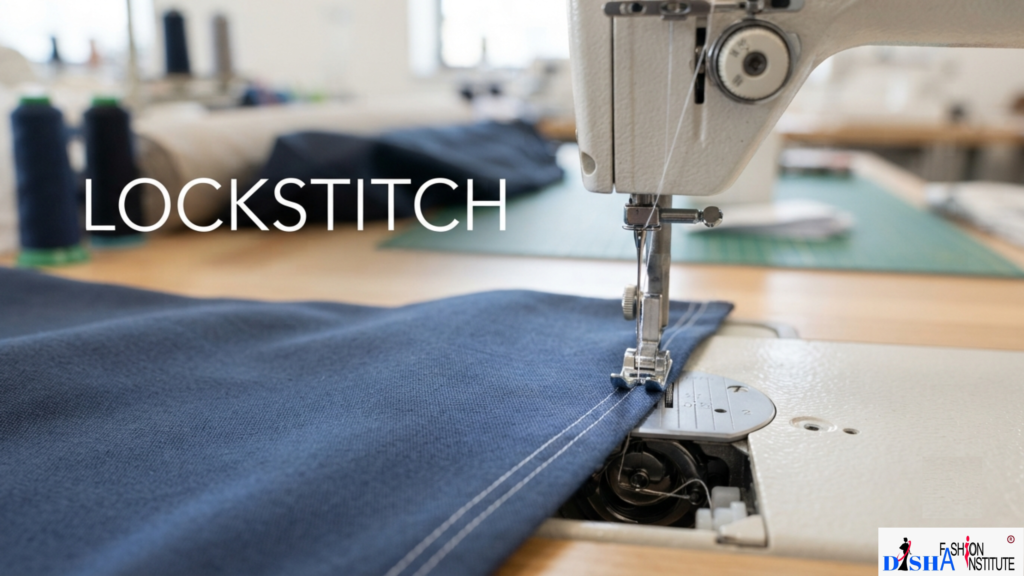
A lockstitch is a sewing stitch formed by interlocking two threads: the upper needle thread and the lower bobbin thread. The two threads meet within the fabric and lock together to create a firm stitch.
In a typical sewing machine, the needle carries the upper thread through the fabric while the bobbin provides the lower thread. The interaction between these two threads creates the characteristic lock of the stitch. This is why it is called a lockstitch.
The most familiar example is the straight stitch produced by many household and industrial sewing machines
How Does a Lockstitch Work?
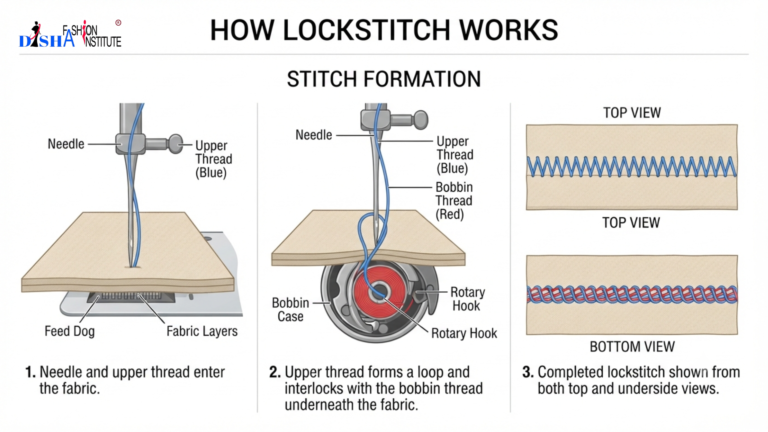
A lockstitch may look simple on the fabric, but several machine parts work together to create it.
The basic process is:
- The needle moves downward and carries the upper thread through the fabric.
- As the needle starts moving upward, a small loop forms in the needle thread.
- The machine’s hook catches this loop.
- The needle thread passes around the bobbin thread.
- The take-up mechanism pulls the thread tight.
- The feed mechanism moves the fabric forward for the next stitch.
This process repeats rapidly, producing a continuous line of locked stitches. In a single-needle lockstitch machine, the needle, bobbin, hook, take-up mechanism, presser foot, and feed mechanism all contribute to consistent stitch formation.
What Makes Lockstitch Different?
The key feature of a lockstitch is the interaction between the needle thread and bobbin thread.
Unlike a chain stitch, where loops are formed using thread from one side, a lockstitch uses two threads that interlace inside the fabric. This gives the stitch a clean appearance on both sides and makes it useful for many types of garment construction.
Where Is Lockstitch Used?
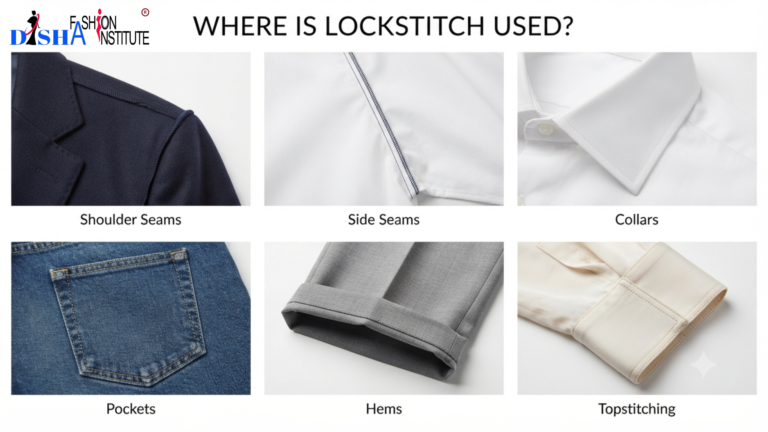
Lockstitch is widely used for everyday sewing and garment construction. It is especially useful when you need a clean and secure seam.
Common applications include:
- Joining garment pieces
- Sewing side seams
- Shoulder seams
- Sewing collars and cuffs
- Attaching pockets
- Making hems and finishing details
- Topstitching
- General dressmaking and tailoring
Single-needle lockstitch machines are also widely used in garment production because they can produce consistent straight seams for sampling and production work.
What Are the Advantages of Lockstitch?
A well-formed lockstitch offers several useful advantages for sewing.
- Neat Appearance
Lockstitch can create a clean and professional-looking line of stitching, making it suitable for visible seams and topstitching.
- Secure Stitch Formation
Because the needle and bobbin threads interlock, the stitch provides a secure structure for many everyday sewing applications.
- Versatile Use
Lockstitch can be used for a wide range of garments and sewing projects, from basic tailoring to industrial garment production.
- Suitable for Straight Sewing
The stitch is particularly useful for precise straight seams, which are essential in many garment-construction processes.
Lockstitch vs Chain Stitch
The main difference between a lockstitch and a chain stitch is how the threads are formed into the stitch.
A lockstitch uses a needle thread and bobbin thread that interlock, while a chain stitch forms interconnected loops. Chain stitches can provide more elasticity, whereas lockstitch is commonly chosen when a neat and secure seam is required.
This does not mean one stitch is suitable for every sewing task. The choice depends on the fabric, garment construction, seam requirements, and desired finish.
Is Lockstitch the Same as a Straight Stitch?
In everyday sewing terminology, the straight stitch produced by a basic sewing machine is generally a lockstitch formation. However, “lockstitch” describes the way the threads are interlocked, while “straight stitch” describes the appearance and direction of the stitching.
So, when you select a basic straight-stitch setting on a sewing machine, the machine commonly produces a lockstitch using the needle and bobbin threads.
Common Lockstitch Problems
Even a simple lockstitch can become uneven if the machine is not correctly adjusted.
Some common problems include:
- Loose or tight stitches
- Uneven stitch length
- Thread breaking
- Skipped stitches
- Thread loops on the underside
- Uneven thread tension
These issues can be related to incorrect threading, unsuitable needle or thread selection, improper tension, or machine timing and adjustment. Proper threading and testing the stitch on a fabric sample before starting the actual garment can help identify problems early.
Why Should Beginners Learn Lockstitch?
For anyone learning sewing, understanding lockstitch provides a useful foundation for learning how a sewing machine creates a seam. Once you understand the relationship between the needle thread, bobbin thread, needle, and fabric movement, many basic sewing operations become easier to understand.
It is especially useful for students learning tailoring, dressmaking, fashion designing, and garment construction because the stitch appears in many everyday sewing applications.
Conclusion
A lockstitch is a fundamental sewing stitch created by interlocking the upper needle thread with the lower bobbin thread. Its neat appearance, secure formation, and versatility make it an important stitch for both beginners and experienced sewing professionals.
If you are learning tailoring or fashion designing, understanding how lockstitch works is a small but important step toward mastering sewing-machine techniques and creating professionally finished garments.
Join Disha Fashion Institute
You can also visit our Homepage or explore our different Course pages to learn more about our programs. If you need any guidance related to courses like Basic Tailoring, Diploma in Tailoring, Fashion Designing, or other fashion-related courses, feel free to contact us. Our team will understand your requirements, skill level, and career goals to guide you toward the most suitable course that matches your learning needs. you can check our YouTube Channel we post our Institute and tutorial over there.