
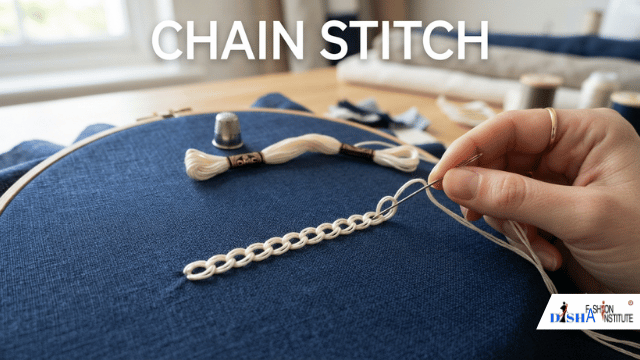
A chain stitch is a sewing or embroidery stitch formed by creating a series of interlocking loops. Each new loop connects with the previous one, producing a continuous chain-like line on the fabric.
Unlike a lockstitch, which uses a needle thread and bobbin thread to form an interlocked stitch, chain stitch is commonly formed using looping thread. It can be created by hand or with specially designed sewing and embroidery machines.
The appearance of chain stitch can vary depending on the technique, thread, fabric, and stitch size. It can create simple outlines as well as attractive decorative patterns.
How Does Chain Stitch Work?
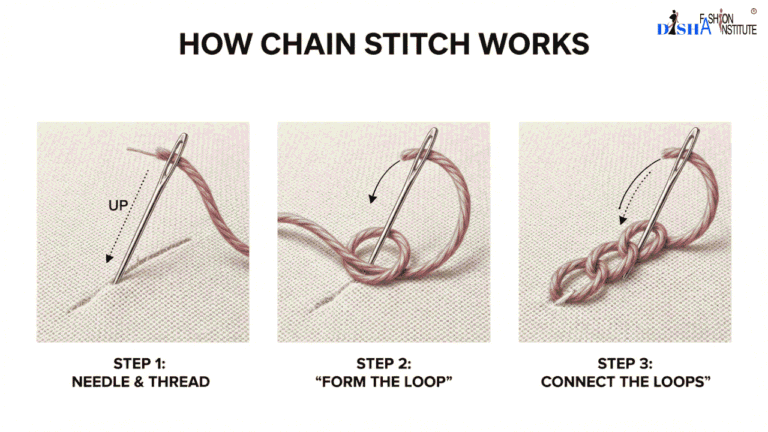
The basic principle behind a chain stitch is the formation of one loop after another.
When making chain stitch by hand, the needle is brought up through the fabric and the thread is positioned under the needle. As the needle goes back into the fabric near the original entry point, it catches the thread and forms a loop on the surface.
The needle then comes up again inside or near the previous loop, creating the next link in the chain. This process is repeated to create a continuous chain-like line.
The important feature of chain stitch is that each loop connects to the next one. When the thread tension is controlled properly, the resulting line looks even and neat.
What Does Chain Stitch Look Like?
Chain stitch is easy to recognize because its surface appearance resembles a series of small connected links.
Depending on the application, the loops can be:
- Small and closely spaced
- Large and decorative
- Straight or curved
- Used individually or combined into patterns
The stitch can therefore be used for simple outlines as well as detailed embroidery designs.
Where Is Chain Stitch Used?
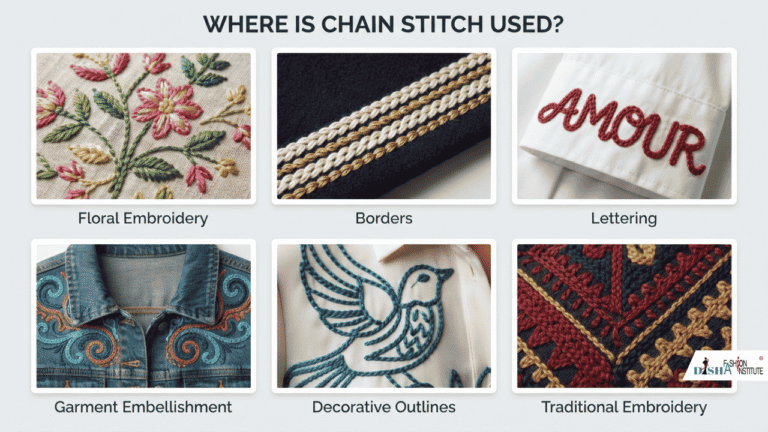
Chain stitch is widely used for decorative and embroidery work. It is particularly useful when a visible, textured line is desired.
Common applications include:
- Embroidery designs
- Floral motifs
- Borders and decorative outlines
- Lettering and monograms
- Garment embellishment
- Traditional and hand embroidery
- Decorative stitching on bags and home textiles
Chain stitch is also used in some types of machine embroidery, where continuous looping stitches can be produced quickly and consistently.
Chain Stitch in Embroidery
Chain stitch is a useful technique for creating decorative embroidery because it can follow curved lines smoothly. This makes it suitable for flowers, leaves, vines, borders, lettering, and other flowing designs.
By changing the thread colour, thickness, loop size, and direction, the same basic stitch can create different visual effects.
For beginners, practicing straight lines and simple curves first can make it easier to develop consistent loop size and thread tension.
Advantages of Chain Stitch
Chain stitch offers several useful benefits for sewing and embroidery.
Decorative Appearance
Its linked-loop structure gives the stitch a distinctive textured appearance that can enhance garments and textile projects.
Suitable for Curves
The continuous loop formation makes chain stitch useful for following curved and flowing designs.
Versatile
It can be used for outlines, borders, motifs, lettering, and other decorative applications.
Can Be Made by Hand or Machine
Depending on the purpose, chain stitch can be produced using hand embroidery techniques or suitable sewing and embroidery machines.
Chain Stitch vs Lockstitch
Chain stitch and lockstitch are formed differently.
A chain stitch creates connected loops, giving it its characteristic chain-like appearance. A lockstitch, on the other hand, is formed by interlocking an upper needle thread with a lower bobbin thread.
Chain stitch is often selected when a decorative or looped appearance is required, while lockstitch is commonly used for general garment seams and precise straight stitching.
The appropriate stitch depends on the fabric, garment construction, durability requirements, and desired appearance.
Common Chain Stitch Problems
Beginners may face a few problems while practicing chain stitch.
Uneven loop sizes can make the stitching look irregular. Pulling the thread too tightly can distort the fabric, while loose tension can create oversized or untidy loops.
Common issues include:
- Uneven loops
- Loose stitches
- Tight or puckered fabric
- Broken thread
- Irregular stitch spacing
Practicing with consistent thread tension and maintaining similar stitch spacing can help produce a cleaner result.
Why Should Beginners Learn Chain Stitch?
Learning chain stitch can help beginners understand how thread loops can be used to create decorative patterns on fabric. It is also a useful foundation for embroidery and textile embellishment.
Once you become comfortable with basic chain stitch, you can experiment with curves, flowers, borders, lettering, and more detailed designs.
It is especially useful for students learning tailoring, dressmaking, fashion designing, and garment construction because the stitch appears in many everyday sewing applications.
Conclusion
Chain stitch is a versatile sewing and embroidery technique made by creating a connected series of thread loops. Its distinctive appearance makes it useful for decorative designs, embroidery, garment embellishment, borders, and lettering.
Whether you are learning hand embroidery or exploring machine-based decorative stitching, understanding chain stitch can help you create attractive and creative textile designs.
Join Disha Fashion Institute
You can also visit our Homepage or explore our different Course pages to learn more about our programs. If you need any guidance related to courses like Basic Tailoring, Diploma in Tailoring, Fashion Designing, or other fashion-related courses, feel free to contact us. Our team will understand your requirements, skill level, and career goals to guide you toward the most suitable course that matches your learning needs. you can check our YouTube Channel we post our Institute and tutorial over there.