
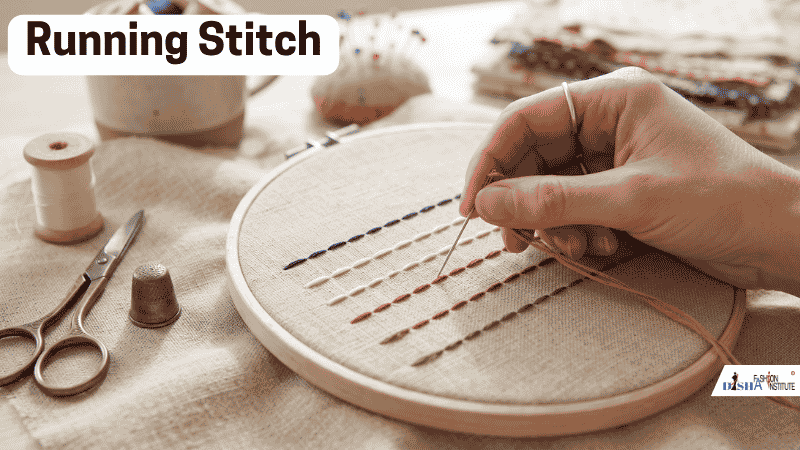
A running stitch is a basic sewing stitch created by passing a needle and thread in and out of the fabric at regular intervals. The finished stitch appears as a series of small, evenly spaced lines on the fabric.
It is one of the simplest hand-sewing techniques and is commonly taught to beginners because its basic movement is easy to understand. Depending on the stitch length and spacing, running stitch can be used for temporary sewing, decorative lines, outlines, and simple embroidery.
How Does Running Stitch Work?
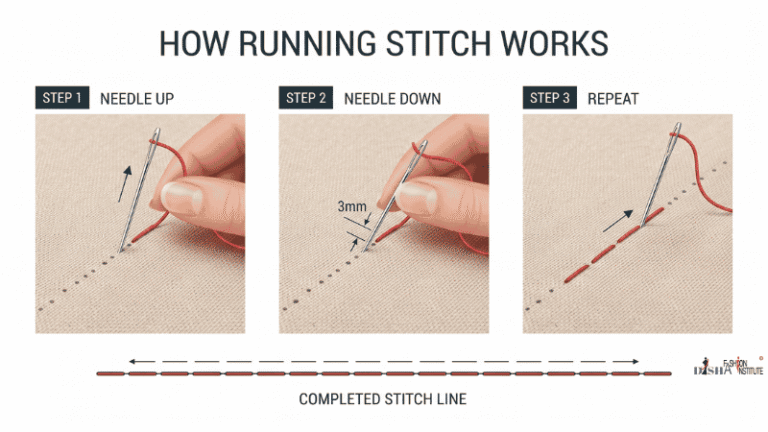
The basic principle of a running stitch is to move the needle through the fabric repeatedly, creating a series of stitches along a selected line.
To make a running stitch:
- Bring the threaded needle up through the fabric.
- Insert the needle back down a short distance away.
- Bring the needle up again further along the line.
- Repeat the same movement to create evenly spaced stitches.
- Keep the stitch length and spacing as consistent as possible.
The visible result is a simple line made up of separate stitches with small gaps between them. Beginners can practice on a straight line before trying curves and patterns.
What Does Running Stitch Look Like?
Running stitch has a simple and recognizable appearance. From the front of the fabric, it looks like a row of short lines separated by small spaces.
The final appearance depends mainly on:
- Stitch length
- Space between stitches
- Thread thickness
- Fabric type
- Thread tension
Small, closely spaced stitches can create a more detailed appearance, while longer stitches produce a lighter and more open effect.
Where Is Running Stitch Used?
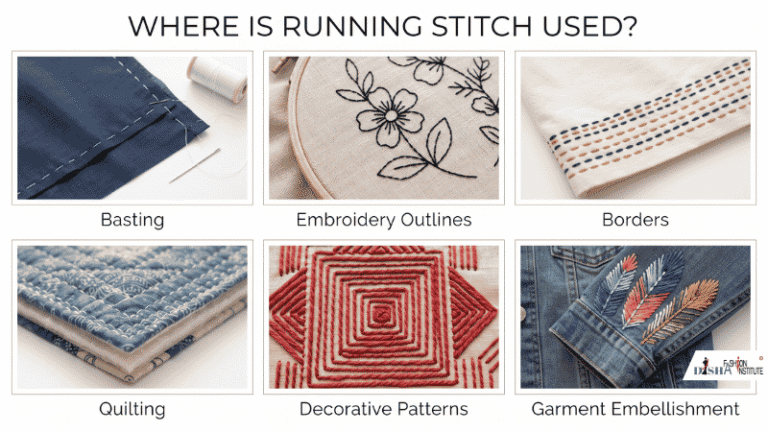
Running stitch can be used for both functional and decorative purposes. It is particularly useful when a simple line of stitching is needed without creating a heavy or complicated finish.
Common uses include:
- Temporary basting
- Simple seam work
- Decorative outlines
- Embroidery patterns
- Borders and motifs
- Quilting and textile crafts
- Marking or guiding stitching lines
- Simple garment embellishment
In hand embroidery, running stitch can be used to create outlines, geometric patterns, borders, and other simple decorative designs.
Running Stitch in Embroidery
Running stitch embroidery is popular because the technique is simple but can create many different patterns. It can be used to outline flowers, leaves, geometric shapes, lettering, borders, and other motifs.
By changing the thread colour, stitch length, and spacing, the same basic stitch can create very different visual effects.
For beginners, practicing straight lines and gentle curves is a good way to develop control before moving on to more detailed embroidery patterns.
By changing the thread colour, thickness, loop size, and direction, the same basic stitch can create different visual effects.
For beginners, practicing straight lines and simple curves first can make it easier to develop consistent loop size and thread tension.
What Are the Advantages of Running Stitch?
Running stitch has several advantages that make it useful for both beginners and experienced sewing enthusiasts.
Simple to Learn
The basic movement of passing the needle in and out of the fabric is easy to understand, making it suitable for beginners.
Quick to Make
Because the stitch uses a straightforward needle movement, simple lines can be completed relatively quickly.
Versatile
Running stitch can be used for temporary sewing, embroidery, decorative work, quilting, and textile crafts.
Creates a Light Decorative Effect
Its separated stitch pattern gives fabric a simple and clean decorative appearance without making the design look too heavy.
Running Stitch vs Back Stitch
Running stitch and back stitch are both commonly used hand-sewing techniques, but their stitch formations are different.
In running stitch, the needle moves forward through the fabric, leaving small spaces between individual stitches. In back stitch, each new stitch is made by moving the needle backward toward the previous stitch, creating a more continuous-looking line.
Running stitch is therefore useful when a lighter, separated stitch effect is desired, while back stitch is often preferred for stronger outlines and more continuous lines.
Common Running Stitch Problems
Although running stitch is simple, beginners may experience uneven results while practicing.
Some common problems include:
- Uneven stitch lengths
- Irregular spacing
- Thread becoming too tight
- Loose stitches
- Fabric puckering
- Difficulty following curved lines
The best way to improve is to maintain consistent thread tension and practice keeping the needle movements at similar distances.
Why Should Beginners Learn Running Stitch?
Learning running stitch gives beginners a foundation for understanding basic hand sewing and embroidery. Once you become comfortable controlling the needle, thread, stitch length, and spacing, you can use the same skills for more detailed decorative techniques.
It is also a useful starting point for anyone interested in hand embroidery, tailoring, quilting, and textile crafts.
Conclusion
Running stitch is a simple and versatile hand-sewing technique made by passing a needle and thread in and out of fabric to create a series of evenly spaced stitches. It can be used for temporary sewing, decorative work, embroidery, quilting, and many other textile projects.
Because it is easy to learn and adaptable to different designs, running stitch remains an important basic technique for anyone beginning sewing or exploring embroidery.
Join Disha Fashion Institute
You can also visit our Homepage or explore our different Course pages to learn more about our programs. If you need any guidance related to courses like Basic Tailoring, Diploma in Tailoring, Fashion Designing, or other fashion-related courses, feel free to contact us. Our team will understand your requirements, skill level, and career goals to guide you toward the most suitable course that matches your learning needs. you can check our YouTube Channel we post our Institute and tutorial over there.