
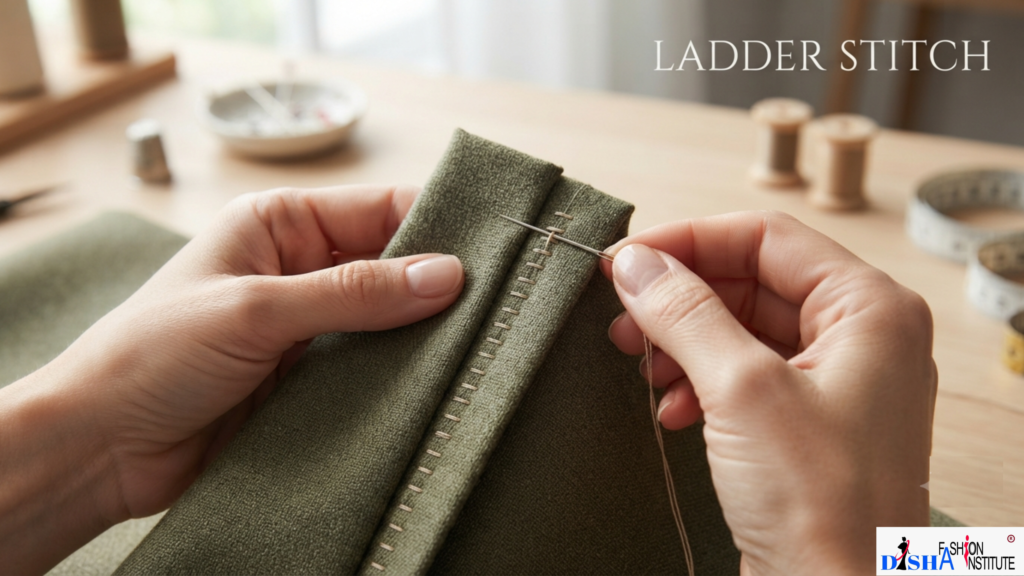
A ladder stitch is a hidden hand-sewing stitch in which small stitches are taken alternately along the folded edges of an opening. Before the thread is tightened, the stitches form a ladder-like pattern between the two sides.
When the thread is gently pulled, the folded edges come together and the stitches move into the fold, creating a clean and almost invisible closure.
This is why ladder stitch is also commonly referred to as an invisible stitch or hidden stitch. Some sewing resources also use terms such as slip stitch or blind stitch for closely related techniques, although the exact terminology can vary.
Why Is Ladder Stitch Used?
The main purpose of ladder stitch is to close an opening without creating a visible row of stitches on the outside.
It is commonly used for:
- Closing stuffed toys and soft toys
- Finishing pillow and cushion openings
- Closing a seam after turning a project right side out
- Repairing small tears and openings
- Finishing some linings
- Joining folded fabric edges
- Hand-finishing areas that are difficult to reach with a sewing machine
It is particularly useful when the opening needs to be closed from the outside while keeping the final finish discreet.
How Does Ladder Stitch Work?
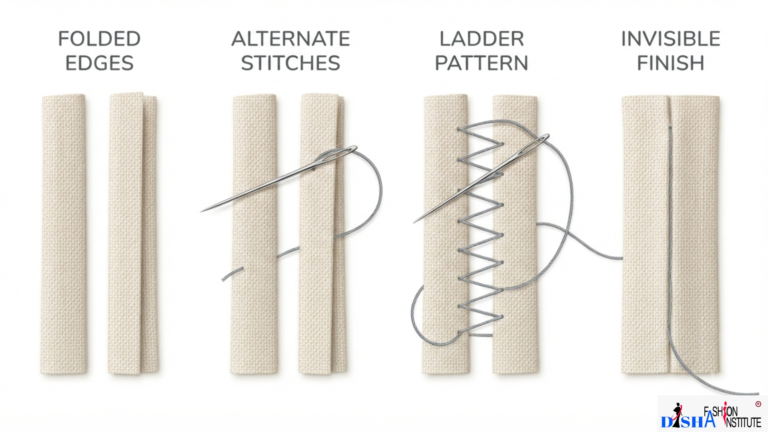
The technique is based on taking small stitches on opposite sides of an opening.
First, the raw edges are folded inward. The needle then takes a small horizontal stitch along one folded edge. It moves across to the opposite side and takes another small stitch.
The process is repeated from side to side, creating a series of stitches that resemble the rungs of a ladder.
Once several stitches have been made, gently pulling the thread brings the two edges together and hides the thread between the folds.
The key is to use gentle, controlled tension. Pulling too hard can cause the fabric to pucker or bunch.
How to Sew Ladder Stitch by Hand
Learning how to sew ladder stitch is quite simple with a little practice.
1. Prepare the Opening
Turn the raw edges of the opening inward and press them if necessary. The two folded edges should meet neatly.
2. Thread the Needle
Choose a fine, sharp hand-sewing needle and thread it with thread that closely matches your fabric.
3. Hide the Knot
Start from inside the folded edge so the knot is hidden. This helps keep the finished seam clean.
4. Take the First Stitch
Insert the needle into one folded edge and take a small horizontal stitch through the seam allowance or folded fabric.
5. Stitch the Opposite Side
Move directly across to the other folded edge and take another small stitch at approximately the same position.
6. Continue Alternating
Repeat the process from one side to the other. Keep the stitches small and reasonably even.
At this stage, the thread should look like a small ladder between the two folded edges.
7. Pull the Thread
After making a few stitches, gently pull the thread. The two sides of the opening will come together and the ladder-shaped stitches will disappear into the fold.
8. Secure the Thread
Once the opening is completely closed, secure the thread with a small knot and hide the thread tail inside the seam.
Avoid pulling the thread excessively because this can create puckering or distort the fabric.
Where Is Ladder Stitch Used?
Stuffed Toys
Ladder stitch is widely used to close the final opening in stuffed toys after they have been filled.
Pillows and Cushions
It can neatly close an opening left for turning or filling a pillow or cushion.
Garment Repairs
When a small seam has opened and cannot easily be repaired from the inside, ladder stitch can provide a discreet hand-sewn repair.
Linings
It can be useful for closing small openings in lined garments and accessories.
Soft Sewing Projects
Bags, fabric toys, bean bags, cushions, and similar projects can benefit from this invisible hand-finishing technique.
Hand-Finished Seams
Ladder stitch can also be used wherever two folded edges need to be joined without a prominent line of stitching.
Ladder Stitch vs Slip Stitch
The terms ladder stitch and slip stitch are sometimes used interchangeably in sewing tutorials, but they can also describe slightly different techniques.
A ladder stitch is commonly associated with closing an opening between two folded edges. The stitches are made on alternate sides and pulled together so the closure becomes nearly invisible.
Slip stitch is often used more broadly for discreet hand-finishing, such as attaching a folded edge, hem, lining, or binding.
Because sewing terminology varies between teachers and sources, it is useful to look at the actual stitch method rather than relying only on the name.
Ladder Stitch vs Blind Stitch
Ladder stitch generally refers to the hidden hand stitch used to close an opening between two folded edges.
Blind stitch, depending on the sewing context, may refer to a discreet hemming technique or may be used as another name for an invisible hand stitch.
For this reason, the terms are not always used consistently. If you are following a particular sewing pattern or tutorial, check the instructions or illustrations to see exactly which technique is intended.
Tips for a Neat Ladder Stitch
For a professional-looking ladder stitch, remember these simple tips:
- Use thread that closely matches the fabric.
- Choose a fine, sharp needle.
- Keep stitches small and evenly spaced.
- Take similar-sized stitches on both sides.
- Keep the folded edges aligned.
- Pull the thread gently rather than suddenly.
- Avoid excessive tension to prevent puckering.
- Hide the starting and finishing thread tails.
- Press the fabric edges before stitching when needed.
Matching thread is particularly important because even a well-made stitch can become noticeable when the thread contrasts strongly with the fabric.
Common Ladder Stitch Mistakes
Stitches are too large: Large stitches are more likely to remain visible.
Thread is pulled too tightly: Excessive tension can create puckering or bunching.
Edges are uneven: If the folded edges do not meet properly, the finished closure may look irregular.
Thread does not match: A contrasting thread can make an otherwise invisible stitch noticeable.
Needle catches too much fabric: Taking large bites of fabric can leave visible marks on the outside.
Stitches are uneven: Inconsistent spacing can make the final seam look untidy.
Final Thoughts
A ladder stitch is a simple and practical hand-sewing technique for creating neat, nearly invisible closures. It is especially useful for stuffed toys, pillows, cushions, garment repairs, linings, and other projects where a sewing machine cannot easily reach the opening.
Once you understand how to alternate small stitches between two folded edges and gently pull the thread to close the gap, this technique becomes easy to master. With matching thread, controlled tension, and neat stitching, ladder stitch can give your sewing projects a clean and professional finish.
Join Disha Fashion Institute
You can also visit our Homepage or explore our different Course pages to learn more about our programs. If you need any guidance related to courses like Basic Tailoring, Diploma in Tailoring, Fashion Designing, or other fashion-related courses, feel free to contact us. Our team will understand your requirements, skill level, and career goals to guide you toward the most suitable course that matches your learning needs. you can check our YouTube Channel we post our Institute and tutorial over there.